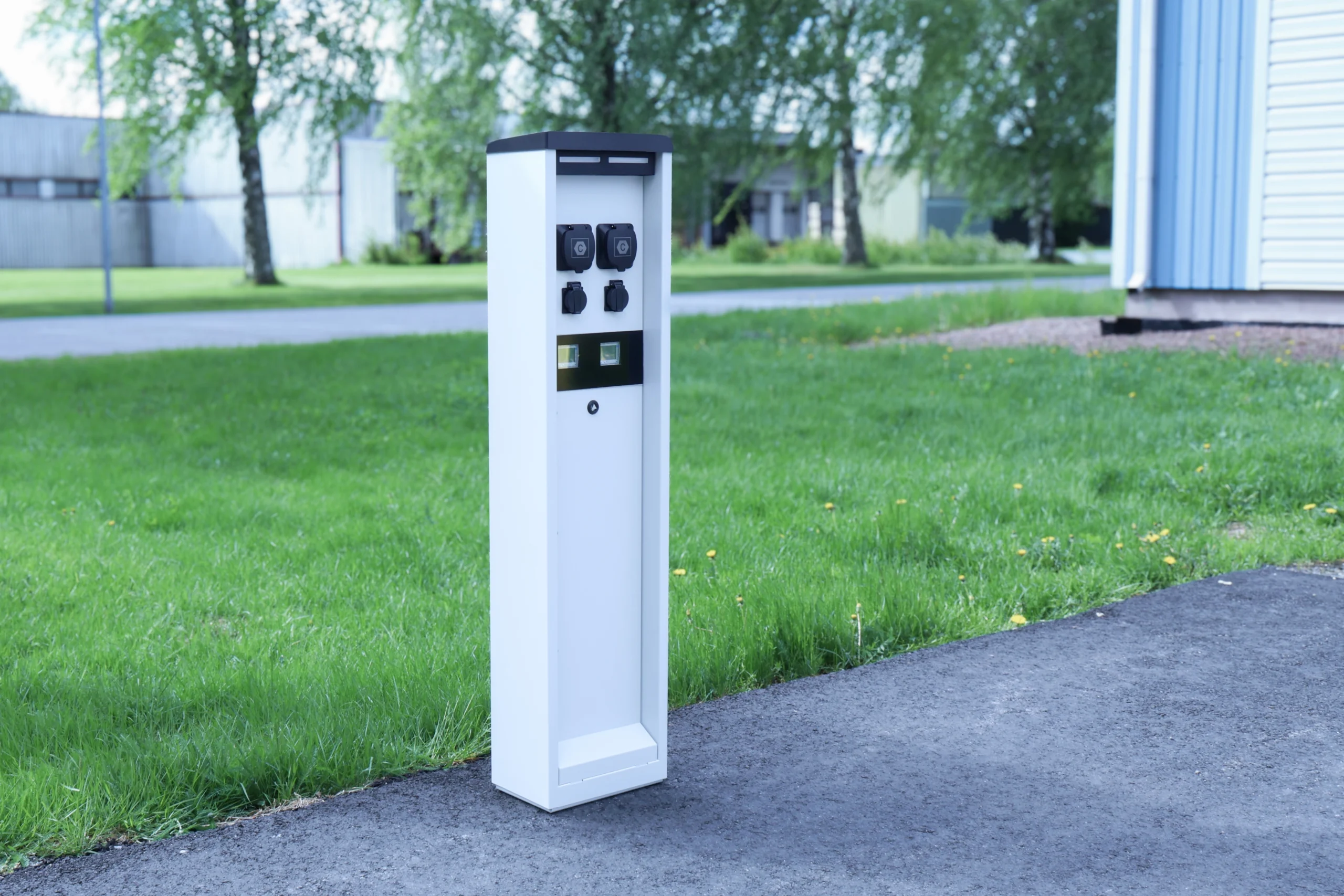
The charger being developed for the ePowerMove Helsinki pilot is entering an important stage of development. The team is currently fine-tuning the industrial design, improving manufacturing processes and strengthening the charger’s mechanical resistance and protection against environmental conditions.
At the same time, the electronics platform has been upgraded and is now being integrated into the new charger design. Once integrated, the system will go through validation and type testing to make sure it can withstand the conditions it will face in real-world operation.
Two principles continue to guide the design: keeping the charger low-cost and making it as unobtrusive as possible. The team is also looking closely at how easily the chargers can be manufactured and installed on site, a crucial aspect for future scalability.
There are still some challenges to solve along the way. Integrating the electronics into a new housing means repeating electromagnetic compatibility (EMC) testing. Intensive testing is currently underway to ensure the charger meets the required emission limits.
Our star feature: bidirectional charging
Bringing V2G into an urban environment is not only a technical challenge. It also raises important questions about how EV battery flexibility can be used, what incentives could encourage users to participate, and how this flexibility can create value for the electricity grid.
The next steps are to finalise the mechanical design and complete type testing, covering mechanical strength, ingress protection, environmental endurance and EMC. The team is also preparing the first field-assembly-capable charger units.
With site introduction planned for autumn 2026, the Helsinki pilot is getting closer to testing low-cost, less intrusive bidirectional charging in a real urban environment.